Sunday, June 22, 2014

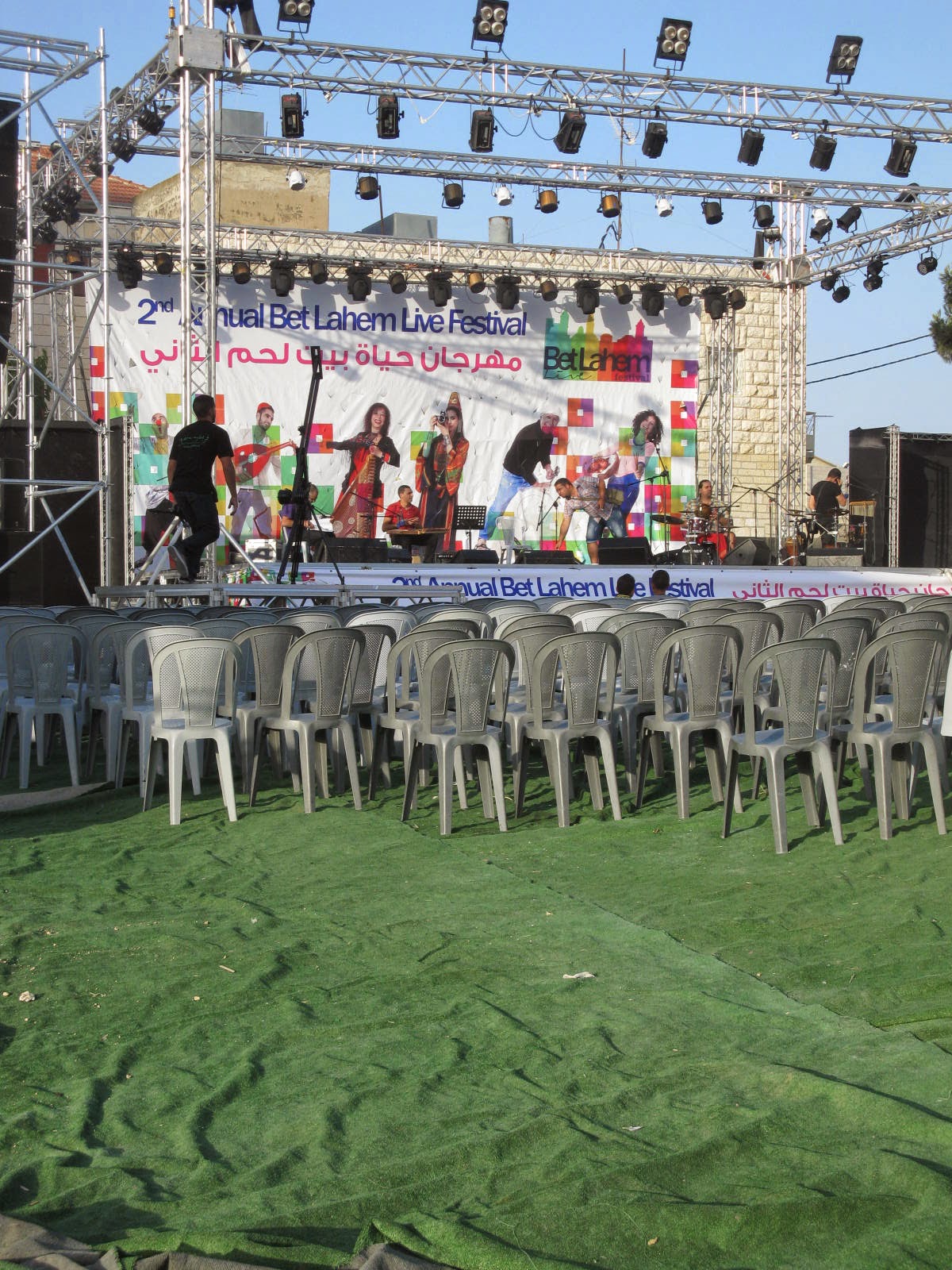
Bet Lahem Live Festival 2014

The Bet Lahem Live Festival has been wonderful!
Lots of work, but well worth it! 


Star Street has been completely revitalized with storefronts open, hubs for live music and art, and cafes for congregating with friends and, of course, smoking some shisha. 


5% of stores that opened for the festival last year remained open year round. We hope for even more this year!

The event kicked off with a parade from manger square to the main stage at the top of the hill on Star Street. 


Incredible artists performed, both local and international.


Keith and I worked behind stage for part of the event. Keith apparently looks like someone who was at the event last year, who must have made a great impression on the artists, because without introduction, everyone loved Keith and spoke to him like a long lost friend.


Though, that is not uncommon in Palestine. Within our first day, we were beginning to recognize people. Even those we have never met greet us with unmatched hospitality. This is a culture of huge smiles, hearty handshakes, and slaps on the back.


 The finale on the last day was supposed to be a local dance group. Everyone was excited. but the evening before, two of the groups' friends were shot in the continued search for the missing Israeli youth / collective punishment of Palestinians by the Israeli army (more on this later). So all of the international artists performed together instead.


Saturday, June 21, 2014

Non Violent Activism: Peace Lectures

Nagler presented at the morning lectures for Bet Lahem Live. He discussed the three faces of power:

  1. Threat Power
    Do what I want or I will do something you don't want
  2. Exchange Power
    Give me what I want and I will give you what you want
  3. Integrative Power
    I will be authentic and it will bring us closer

Here is a recording of Nagler's presentation. 

After his presentation, he led a small group of interested participants in a meditative practice for nonviolence that aims to soak words and thoughts of peace, grace, reconciliation, love, and kindness deep into the subconscious.

The talks were attended by unarmed civilian peace keepers. Groups like the Ecumenical Accompaniment Programme in Palestine and Israel (EAPPI) provide 'protective presence' by living with vulnerable populations and being witness to their struggles. Visit their website to view eyewitness reports. 

Friday, June 20, 2014

Non Linear Leadership

I attended a presentation today by Sami on non-linear leadership.

Two main concepts I took away from this discussion:


  1. There are three realms: The past, present, and future. Both the past  and future realm exist only in conversation (either internal or external). The present is the realm of action.
  2. People tend to cycle back and forth between the past and present. The conversation of the past influences the actions in the present. Nonlinear leadership is about breaking that cycle.

    While still honoring and learning from the past, nonlinear leaders make decisions in the present that are based on a desired future rather than the past. 


Sami believes this is key for Israel and Palestine. He wants to see more people taking pause in the present to think of new and creative ways to act and begin building a peaceful future.


Wednesday, June 18, 2014

Holy Land Trust

Keith and I are interning with an organization with a mission, vision and value of peace.

Not the political peace that is constantly debated in the region, but a true and deep-rooted peace that is born in the hearts of individuals.


The Executive Director tells the story of his grandmother. His father grew up in Jerusalem, in a neighborhood with Jews, Muslims, and Christians. His father and other Christian and Muslim children would help their Jewish neighbors on the Sabbath by turning on their lights at night (which they cannot do, since they cannot work).

And so, the director does not believe that the conflict in the Holy Land is about religion, but about politics and commerce, using religion.

In 1948 his father's family had to flee their home in Jerusalem, and lived in a refugee camp in Bethlehem. And his grandmother made it clear to his father, and to him, and to everyone in her family, that they would not be a family that sought vengeance. That their family would always work for reconciliation and peace.


Church of the Nativity

Keith and I came just in time for the Bet Lahem Live Festival. This four day event focuses on culture, justice, and faith. In the morning there are conference style lectures on peace and non-linear leadership. Throughout the day, shops will open on Star Street. In the evening, artists, musicians, dance, and theater groups will perform on two stages.

Star Street is the original street heading into Bethlehem. It would have been the street Mary and Joseph used, or the wise men, and countless pilgrims afterwards.

In 2000, there were 98 shops lining the streets. Now, there might be 18. The 2nd Intifada has severely impacted tourism and commerce on this road. Today, the street seems abandoned. Lines of green doors are bolted shut. No one is shopping or socializing here. I cannot imagine what this festival will look like, or how we will pull it off by tomorrow. 


Keith is in his glory. Event planning. Volunteer coordinating. Having opinions :-)

In the void of structure, by western standards, Keith has attracted a following of college students who hang on his every instruction.

Since Keith and I are older than the average volunteer, those in charge of the festival will give us general tasks, and ask us to figure out the details with the volunteers.


For example, we were asked to clear away some of the chairs in front of the stage so there would be room for dancing. Keith quickly envisioned a highly detailed arrangement of where to put chairs and where to leave aisles. Completely arbitrary, but the kind of thing task-oriented interns in a people-oriented culture crave.

When Keith ran to take care of something else, and it became evident that we had to do something with the extra chairs, I instructed the group to add one more row, to which everyone protested, citing Keith's exact orders. I need to learn to speak with his authority.


 I was able to write a press release. That's more my niche.

In the meantime, I am in my glory, because I love to be surrounded by energy, people, food, music, and art. Should be a great event!


Tuesday, June 17, 2014

Kidnapping

On June 12th three Israeli teens (aged 16 and 19) disappeared. The Israeli news calls it a kidnapping. Since then, the Israeli army has been conducting raids in Palestine, searching for the missing youths, and attempting to apply pressure to Palestinians in general.

There are several reports of the Israeli army blasting through the doors of homes and businesses at night, ransacking and confiscating what is inside, leaving a wake of lasting damage. These are not targeted raids - they move from house to house. Palestinians are blindfolded, and taken away in cars without allegations. Palestinian children under the age of 13 are arrested from school, escorted by soldiers as they cling to their teachers in terror.

In five days, the army has arrested over 200 people. The word 'kidnap' gets a bit muddled.


And so, when the Israeli army is mobilized in Palestine, youth will often congregate and throw rocks and bottles at the soldiers.

We heard today that during a raid, the army fired live ammunition into a crowd throwing rocks, and killed a 20-year-old. Blasting through the door of a home, shrapnel was lodged into the head of an eight year old.

You expect things to be tense here. I have only just arrived. But these kidnappings, on both sides, seem to weigh heavily on the minds and hearts of those I am meeting.

Monday, June 16, 2014

Israel/Palestine 101

A lot is happening here. Before jumping into the details of each day, we wanted to provide a high level overview of the situation, including key terms and dates.

So Katie and I are going to attempt to give a very basic history of the Israel-Palestine situation for context. Clearly, we are not experts. As you know, this is quite complex. There are many opinions, and many ways to find out more information.

Pre-20th Century: History dating back 20 million years. Things happened.

Early 20th Century: An awkward mix of Zionism and anti-semitism in the US and Europe generates a lot of talk about a Jewish Homeland.

1918: The British take control of Palestine from the Ottoman Empire

1939-1945: Millions of Jewish people are killed in Europe during WWII. Some Palestinian Jewish people help to smuggle Jewish refugees into the area.

1946-1947: Land disputes break out in Palestine. Britain 'gives leadership of Palestine' over to the United Nations. The UN votes on a two state solution, in which Israel receives 56% of the land, and Arab Palestinians receive 44%. Arab leadership is discontent with this arrangement, since they controlled much more before Britain.

1948 (Al-Naqba): The British withdraw from Palestine. Jewish Palestinians declare independence, and the state of Israel is formed. Neighboring Arab states (Egypt, Jordan, Iraq, Syria, Lebanon) invade, based on their own nation's economic interests. The Jewish state wins.

It should be noted that Palestinian Arab leadership had little say in the actions of their neighboring nations , though they were most affected by decisions on both sides. In the end, the lost an additional 20% of their land.

This war is referred to by Israeli Jews as the War of Independence. Palestinian Arabs call it Al-Naqba, or The Catastrophe. Over 600,000 Arabs living in what would become Israel fled their homes or were kicked out by the Israeli army. Many of them took nothing with them, except their keys, expecting to return shortly.

Post 1948: With Jewish immigrants pouring in from Europe and other Arab countries, the population of Israel more then doubled in three years. The US begins a strong relationship with Israel, based on oil interests in the region, although not too publicly.

1967 (The Six-DayWar): Verbal and economic aggression and threats by nearby Arab states, most notably Egypt, create the impression that physical action may be taken against Israel. Fearing the possibility of attack, Israel preemptively attacks bases in Egypt, Syria, and Jordan, thereby taking Sinai from Egypt, the Golan heights from Syria, and the West Bank from Jordan. These areas become part of direct Israeli military control.

1970's and 80's: Attempts at peace and a two state solution. Extremists on both sides (militant Palestinians who want to revoke Israel as a state, and right-wing Zionists who want the entire region to be Jewish, annexing all of Palestine) object.

Many Jewish settlements are built on Palestinian land. This breaks international law, the the UN is powerless, based on the US relationship with Israel (more on this below).

1987-1989 (The First Intifada, "Shaking Off"): Mentally, physically, and economically worn out by the Israeli occupation, Palestinians rise up to get Israel out of their territories.

Though much of the Intifada was nonviolent, there was violence as well, which gained much publicity. Israel's response was harsh, drawing condemnation from other nations for being disproportionate. (We will post more later about how Palestine is occupied, with maps on Areas A, B, and C, etc.)

1990s (Oslo and the Peace Process): Yitzhak Rabin, Israel's Prime Minister, worked with Yaser Arafat and the US (via Clinton) towards peace. There was a lot of hope, as Rabin was respected by both right and left-wing Israelis (he was a leader in the 1948 war, and chief of staff of the military in the 1967 war).

In 1995 Rabin was assassinated by a right-wing Israeli who didn't want the country to cede any land back to Palestinians. His death marked the end of much of the peace process. Settlements continue to grow in the west bank and Gaza strip.

2000-2005 (The Second Intifada): As the peace process stalled, and the economic situation for Palestinians grew more dire, there was another uprising against the Israeli occupation. This was more violent than the first, with an increase in suicide bombers. Israel's response was again disproportionate, and often directed as collective punishment towards all Palestinians.

Israel's response to the second Intifada was to build a wall into Palestinian territories, separating all occupied Palestine from the rest of Israel. Though originally intended to be built on the borders of the 1967  war, the wall instead was built deep into Palestinian territory, confiscating farm land, destroying houses, splintering communities, and creating significant economic barriers (more on all of this later).

Into 2000: In 2006, Hamas wins political power through democratic elections in Gaza. Ariel Sharon, Israel's prime minister, begins the process of pulling settlers from occupied area in Gaza Strip. Fatah, the other major political power, retains power in the West bank.

No progress on the peace process in the last decade. Israel has refused to stop building settlements in the West Bank.


A few more things of note:

Economics: The GDP per person in Israel is $29,900/year. The GDP per person in the West Bank is 2,900/year.

Religion/Ethnicity: Palestinians are overwhelmingly Arab, though there is a mixture of ethnicities. Not all Arabs are Muslim. There is a significant Arab Christian population (about 30% where we're at).

Like their Muslim neighbors, 1 million  Palestinian Christians were displaced during The Catastrophe.

Settlers: Generally, there are two reasons Jewish people settle in Palestine. There are economic settlers, who relocate for the government's significant economic incentives. Housing, land, and other expenses are much cheaper than in Jerusalem and other Israeli towns.

The second are ideological settlers, primarily Zionists who see it as their right to live on all land that was historically part of Israel. We have heard that both Israeli soldiers and Palestinians are more frightened of extremist ideological settlers than they are of each other. Clearly, not all settlers or Zionists are violent.

Refugees: Palestinians make up the largest refugee population in the world (about 5 million). They are spread throughout neighboring countries, like Syria, Lebanon, and Jordan, as well as in occupied territories in the West bank and Gaza Strip.

In a song...


There is no denying that significant violence has been done on both sides of this conflict. There are tactics for causing terror used by both Israelis and Palestinians. There is fear, pain, exhaustion. There is also peaceful, kind, generous, and loving people everywhere we go. Lots of them!

We will try to show the nuances of both sides, but since most of what we hear in the US slants towards the Israeli side, and because we are currently located in (hosted by, meeting people from) Palestine, we will give more time and attention to the Palestinian experience.


Sunday, June 15, 2014

Jerusalem in Photographs

Outside the Damascus gate


Church of the Holy Sepulchre

On the wall's ramparts


Early pilgrims who came to the Church of the Holy Sepulchre would carve a cross on the walls for everyone who arrived safely.

At the Western Wall

In front of the Dome of the Rock, on the Temple Mount


Views from the rampart walls.


Yehuda Market goodies


Ethiopian food with Colin and Nicole DeGraf